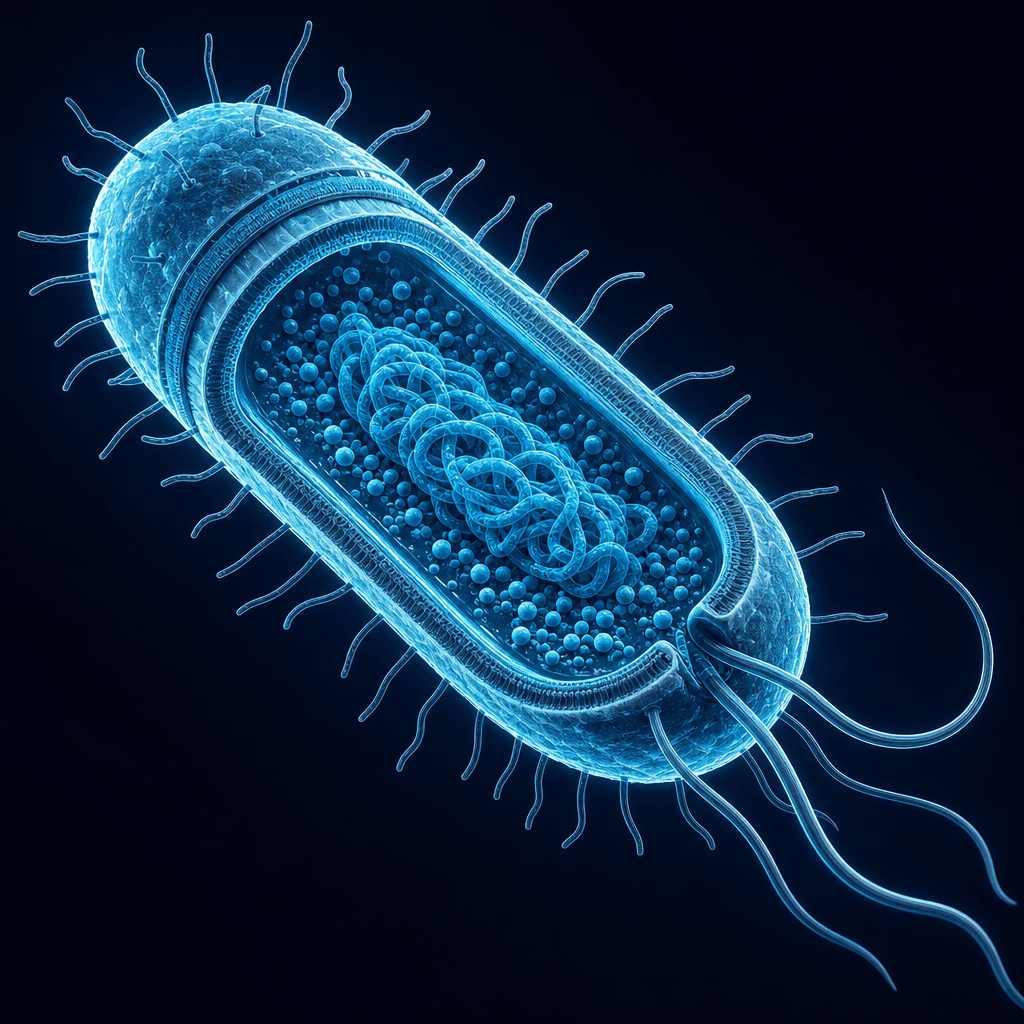
Bacterium
E. coli is one of the most studied prokaryotic organisms. As a gram-negative rod-shaped bacterium, it serves as a model organism in microbiology and biotechnology research. Its well-characterized genetics make it invaluable for recombinant protein production.
The cell wall provides structural integrity and protection. In gram-negative bacteria like E. coli, it consists of a thin peptidoglycan layer sandwiched between the inner and outer…
The outer membrane is unique to gram-negative bacteria. It contains lipopolysaccharide (LPS) molecules that act as endotoxins and serve as a selective permeability barrier, protect…
The nucleoid is the region containing the bacterial chromosome — a single circular DNA molecule approximately 4.6 megabase pairs long encoding ~4,300 genes. Unlike eukaryotes, it i…
Bacterial ribosomes are 70S particles composed of 30S and 50S subunits. They are the sites of protein synthesis, translating mRNA into polypeptide chains. Their structural differen…
The bacterial flagellum is a helical filament driven by a molecular rotary motor embedded in the cell envelope. Rotating at up to 1,000 rpm, it propels the bacterium through liquid…
Pili are proteinaceous surface appendages. Type I fimbriae mediate adhesion to host cells and surfaces, facilitating biofilm formation. Sex pili (F-pili) are essential for bacteria…
Plasmids are small, circular, self-replicating DNA molecules separate from the chromosome. They often carry accessory genes such as antibiotic resistance determinants and can be tr…